



GIBA and IPS Group Announce Strategic Partnership
November 24, 2025
Indien zuerst: Merz-Reise setzt starkes Signal – jetzt braucht es politische Konsequenz
January 14, 2026
India- Germany Partnership That Must Finally Deliver at Industrial Speed
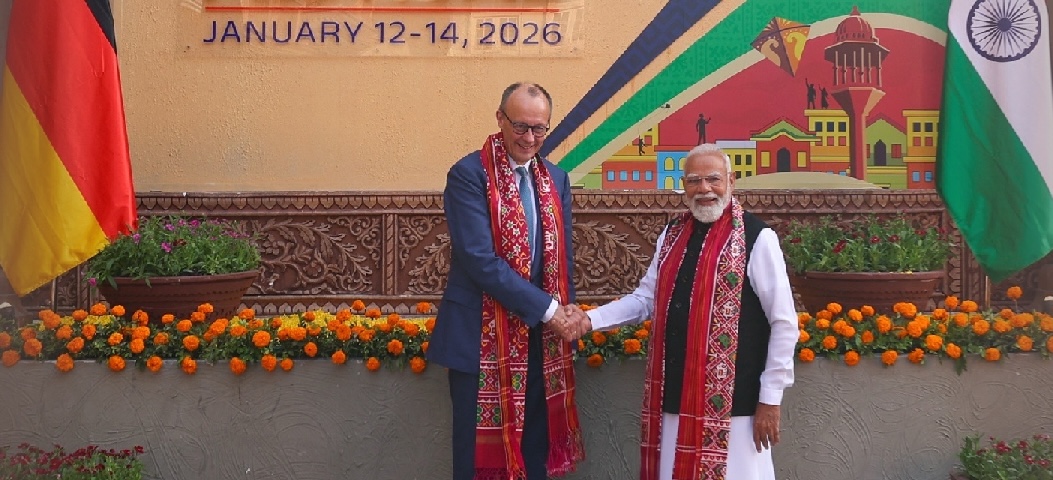
When Germany’s Chancellor Friedrich Merz landed in India on January 12–13, 2026, the symbolism was carefully chosen: this year marks the completion of 25 years of the India–Germany Strategic Partnership and 75th anniversary of diplomatic relations. The optics were warm—CEOs in tow, public camaraderie on display, and an itinerary that moves from Ahmedabad’s political stage to Bengaluru’s innovation corridor.
But anniversaries are not an economic strategy. The real question is whether this visit becomes the moment when two capable democracies that are celebrating their potential—also start converting it into shared industrial power.
A deal-heavy visit
The outcomes were substantial: 19 agreements/MoUs and 8 key announcements spanning defence industrial cooperation, a CEO Forum embedded in a joint economic committee, a semiconductor ecosystem partnership, cooperation on critical minerals and telecommunications, bioeconomy R&D, extension of the Indo-German Science and Technology Centre, a higher education roadmap, and a framework for ethical recruitment of healthcare professionals. Germany also announced visa-free transit for Indian passport holders through German airports, and both sides adopted a Digital Dialogue Work Plan (2025–2027). On the green economy, Berlin committed €1.24 billion under the Green and Sustainable Development Partnership, with a new battery storage working group and scaled triangular projects in Africa.
All of this signals seriousness. Yet the hardest work starts after the cameras leave: building the institutional plumbing that turns declarations into deployment.
Skilled mobility: from headline to highway
Germany’s demand for skilled professionals and India’s depth of talent form a clear strategic fit—and Chancellor Merz’s visit usefully reinforced this agenda with a more practical, outcomes-oriented tone. If this intent is sustained, mobility policy can become a genuine competitiveness tool: faster, predictable movement of professionals shortens project timelines, reduces capacity gaps in critical sectors, and strengthens innovation on both sides.
To convert this momentum into measurable productivity gains, the focus must now shift from intent to execution—with operational clarity that professionals and employers can rely on. Transparent, time-bound processing for visas and work permits, profession-specific pathways for recognition (particularly in regulated roles), and scaled bridging programmes would make transitions smoother and faster. At the same time, the most persistent bottleneck must be addressed directly: German language proficiency requirements, which often slow recruitment and integration even when skills are urgently needed. Expanding affordable, high-quality language training—paired with job-linked immersion pathways and sector-specific language modules—would remove friction at source, ensuring mobility becomes durable, not temporary, and planned with confidence rather than uncertainty.
The partnership’s real test
The most consequential themes in the outcome list were not ceremonial—they were geopolitical: semiconductors, critical minerals, telecom, defence industrial cooperation, and bioeconomy R&D. These are the chokepoints of modern economic sovereignty, determining who controls supply chains, sets standards, and retains strategic autonomy. In that sense, the visit signals a shift from a transactional relationship to one that is increasingly about shared resilience and industrial capability.
The joint statement also makes the intent explicit: a defence industrial roadmap anchored in co-development and co-production. The logic that drives defence cooperation, if extended beyond defence into a clearly defined deep-tech portfolio—industrial AI, quantum-ready security, cyber resilience, power electronics, biomanufacturing, clean hydrogen value chains, and advanced storage—backed by measurable milestones and sustained funding would be impactful for India. The fastest and most credible route to make this real is to institutionalise cross-border industry–academia partnerships: joint labs, shared testbeds, co-supervised doctoral pipelines, IP frameworks that reward collaboration, and challenge-driven programmes where universities and companies build deployable solutions together.
The EU–India FTA: the multiplier waiting behind this visit
This is not only a Germany–India moment; it is increasingly a European Union–India moment—and the timing appears deliberate. During his India visit, Chancellor Friedrich Merz publicly pressed for the EU–India free trade agreement (FTA) to be brought to closure, Merz suggested a conclusion as early as late January 2026. Against that backdrop, New Delhi’s Republic Day–linked invitation to the EU’s top leadership has been widely read as more than ceremonial diplomacy: it signals a conscious effort to elevate the EU relationship at a time when trade, technology, and strategic alignments are being reshaped globally. In that setting, the expectation that the FTA could be signed at the summit feels less like conjecture and more like the logical endpoint of intensifying political engagement.
A concluded FTA would immediately expand the scale of everything being discussed—from investor confidence and long-horizon supply planning to the ability of firms to build EU–India value chains that serve both competitiveness and resilience. Yet the final stretch is rarely smooth. Negotiations have repeatedly snagged on market access and rules of origin, while climate-linked trade instruments such as the EU’s Carbon Border Adjustment Mechanism (CBAM) have added another layer of sensitivity. The most credible “win” in January, therefore, is one that is economically meaningful and operationally actionable—clear enough for businesses to plan against and for governments to defend at home—while allowing any remaining technical chapters to be completed with discipline in the weeks that follow the summit.
If India-EU summit does culminate in an EU–India trade breakthrough, it should not be judged by the symbolism of the signature alone, but by what follows matters - clearer rules that reduce transaction costs, faster approvals that unlock investment decisions, and early sectoral wins that companies can point to as proof that the agreement is working on the ground. The mood in Delhi & Berlin is unmistakably more purposeful than in past cycles—and that deserves recognition. Still, businesses will reserve their full confidence until timelines, compliance pathways, and implementation responsibilities are set out in plain terms.
If the EU–India FTA— decades in the making—does finally cross the line, it will be remembered less for how long it took and more for whether it quickly changes the cost and speed of doing business. The hope now is that this long negotiation produces an outsized impact: early, visible gains in trade flows, investment decisions, and supply-chain commitments that prove the agreement is more than a diplomatic trophy. And that is precisely where Merz’s India visit returns to the frame—because Germany’s push on skilled mobility, technology cooperation, and industrial partnerships will only look truly strategic if the wider EU–India trade architecture converts momentum into measurable outcomes.